

What if the problem isn't what you're building - it's the foundation you’re building it on?
Most transformation efforts focus on strategy, vision, or innovation. But the foundational work? It happens in the invisible architecture—the narratives we inherit, the structures we mistake for reality, and the operational choices that determine whether visionary ideas actually get built.
The Foundation Sessions, presented in partnership with RALLY, is the inaugural installment of The Futurist Salon Series bringing together three leaders examining different dimensions of the same question: What does it take to build a foundation itself - the structures, narratives, and systems that determine what becomes possible?
Across three conversations, we'll move from questioning what we accept as fixed (with Shumeca Pickett), to examining the stories shaping what gets built (with Sean Anderson), to understanding the operational mechanics that turn vision into sustainable reality (with Alvin Schexnider).
Each conversation, hosted by Future Mapping's founder Shumeca Pickett, creates space to examine, question, and design the realities we need.
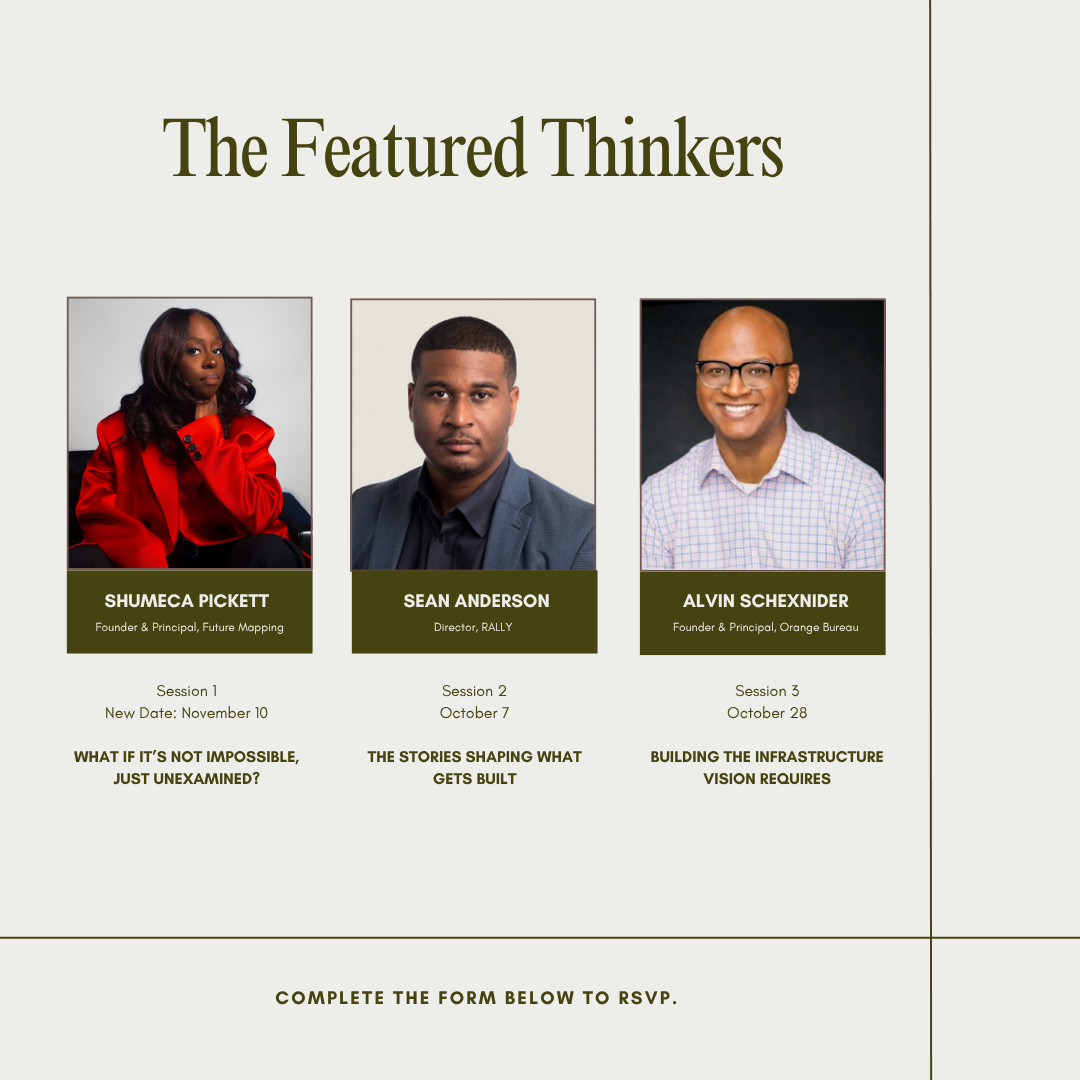
Session Descriptions
-
What If It’s Not Impossible, Just Unexamined?: A Conversation with Shumeca Pickett
Shumeca Pickett examines how the most impactful strategies are rooted in humanity and compassion. Not just solving complex organizational challenges, but building pragmatic, equitable systems designed to support collective well-being.
As Founder & Principal of Future Mapping, Shumeca has spent over two decades advising executive leaders across corporate enterprise, public systems, and philanthropy on translating ambitious vision into sustainable reality. Her background spans executive leadership as Managing Director at FSG, serving as the inaugural Director of Civic Partnerships for World Business Chicago, scaling cultural enterprises like Hebru Brantley’s Nevermore Park, and driving market innovation as Vice President at JPMorgan Chase.
Rooted in a family legacy of purpose-driven leadership and informed by Afrofuturist inquiry, she has learned that moving from visionary idea to lasting transformation requires facing the unexamined foundations beneath our work. Through her experience across sectors, Shumeca has demonstrated that what often appears as an impossible external constraint is actually an inherited assumption waiting to be interrogated and redesigned.
Beyond Surface-Level Innovation
We are living through a moment where leaders are responding to the call to build new institutions, transform existing organizations, and reimagine systems that no longer serve their intended purpose. Yet many find themselves optimizing within structures that need fundamental interrogation—improving delivery mechanisms without questioning whether the underlying framework itself requires rebuilding.
Translating ambitious vision into sustainable reality, building institutions that honor both humanity and operational excellence, and confronting the systemic friction that stalls progress requires more than incremental change. It demands examining which foundations we're building on and whether those foundations themselves need questioning first.This conversation is for builders and leaders across sectors who suspect their biggest limitations aren't external—whether you're founding something new or leading transformation in an established organization—and who recognize that what appears impossible may actually just be unexamined.
What we'll explore:
Which constraints are you accepting as unchangeable that are actually inherited assumptions? How do the systems and frameworks you inherited determine what you imagine as possible? What does it take to build something that questions foundations from the start—or to transform what exists by examining the structures beneath it?
What you'll leave with:
A sharper lens for distinguishing inherited assumptions from structural reality in your own work. Critical questions to help you identify which constraints are actually changeable and which foundations need interrogating before you build or rebuild.
A clearer sense of where what you've accepted as "impossible" is actually just unexamined—and whether your current strategy, operations, and innovation efforts are built on assumptions that require questioning first.
If you've ever wondered whether you're solving the right problem or just optimizing within the wrong structure, this conversation offers a dedicated space for that rigorous inquiry.
-
The Stories Shaping What Gets Built: A Conversation with Sean Anderson
Sean Anderson understands that narrative isn't decoration—it's infrastructure. The stories we tell about our work, our organizations, and our industries don't just describe what we're building. They determine what becomes structurally possible.
As a communications and political strategist with over a decade of cross-sector experience, Sean has guided Fortune 100 companies, major foundations, and grassroots advocacy organizations through the work of narrative transformation. At RALLY, he helps clients communicate the need for change and shift public narratives using data-informed strategies and nuanced audience insights. A product of Chicago politics, Sean served as communications director for Illinois House Speaker Emanuel "Chris" Welch, worked at World Business Chicago, and led several political campaigns throughout the city and state. Today, he straddles Chicago and L.A. to drive progress on national issues.Through this work, he's learned that most organizations are building on narratives they inherited without ever examining whether they're true. The gap between institutional vision and operational reality often isn't a failure of strategy or execution—it's a narrative problem. The stories shaping what gets built create either expansion or constraint, possibility or limitation.
Beyond Surface-Level Storytelling
We're living through a moment where it’s more broadly known that the narratives supporting our organizations, industries, and civic systems were never complete to begin with—they were designed to serve specific interests and exclude others. Those deliberate gaps are now the limits of what we believe we can build.The stories we've inherited about how change happens, who leads it, and what's structurally possible are colliding with new realities that demand different frameworks.Moving past surface-level innovation requires facing an honest reality: the narratives shaping your organization's strategy, operations, and innovation work are either creating the conditions for transformation—or quietly anchoring your work to legacy assumptions that limit your impact.
Shifting narrative foundations isn't cosmetic work. It requires structural rigor, strategic clarity, and a willingness to examine the stories underneath the systems before you build—or to rewrite the stories shaping what already exists.
This conversation is for builders and leaders across business, government, and civil society who recognize that transformation requires questioning the narratives we operate from, and who see how unexamined stories can quietly cap progress.What we'll explore:
Which narratives are you operating from that determine what gets built, and where are unspoken assumptions creating quiet friction in your strategy? How do the stories you tell about your work expand what you can achieve, or reinforce limits that no longer serve your mission? What does it take to shift the narrative foundation before you build, ensuring your public stories align with the reality of what your systems can actually deliver?
What you'll leave with:
Clear insight into the narratives constraining what you're building—and a method for identifying where inherited stories are creating structural misalignment between what you say you're building and what your systems can actually deliver.
A grounded perspective on how narrative functions as structural intervention, and sharper questions to help you assess whether the stories shaping your organization are creating expansion or limitation.
An expanded sense of connection to a broader ecosystem of cross-sector leaders confronting these same narrative and structural challenges.
If you've ever felt stuck in a story you didn't write, this conversation examines how narrative shapes what becomes structurally possible—and what it takes to rewrite the foundation. -
Building The Infrastructure Vision Requires: A Conversation with Alvin Schexnider
Alvin Schexnider studies the gap between institutional vision and operational reality. Not the strategy, but the structural integrity that makes transformation executable across systems that actually serve people.
As a strategic advisor, Alvin has led large-scale transformations across tech, corporate enterprise, and public systems. His background spans leading experience design initiatives at Capital One, guiding cross-border change management during major corporate acquisitions, and serving as the State of Illinois' first Chief People Officer and as a lead COVID-19 response strategist at IDHS—where he transformed key operational systems for a 14,000-person agency.
Through this work, he’s learned that moving from bold strategy to sustainable implementation isn't a failure of vision or commitment. It is an execution and design challenge. It requires designing systems that withstand pressure, adapt to shifting conditions, and deliver on their promises—the specific structural choices that determine whether transformation becomes operational reality or dissolves into chaos.
Beyond Quick Fix Innovation
We are living through a moment where the foundational infrastructure supporting our organizations and cities—from workforce pipelines and operational models to civic systems—is reaching its limits, experiencing structural friction, or being dismantled. Moving past surface-level innovation requires facing an honest reality: building enterprise resilience and civic capacity isn't a quick fix, but a generational effort that begins with the ground-level solutions taking root in our cities.
Building infrastructure capable of supporting the future requires structural rigor, strategic cross-sector partnership, and a long-term horizon. The gap facing our organizations often isn't conceptual, it's a challenge of execution, operational capacity, and alignment.
This conversation is for builders and leaders across business, government, and civil society who recognize that critical infrastructure is actively decaying or being dismantled, and who are actively leading the local, on-the-ground work required to reassess, rebuild, and advance the operational and economic capacity our region depends on.
What we’ll explore:
What core values must guide the work forward? As new vision emerges across our city, who will carry out this building effort, and how do we weave local initiatives and enterprise models into collective, resilient ecosystems instead of working in isolation?
What you’ll leave with:
A grounded perspective on the scale, effort, and structural rigor needed to move operations, markets, and institutions forward.
Sharper questions to help you interrogate institutional operational failure points, evaluate legacy assumptions, and map necessary capabilities in your own work.
An expanded sense of alignment and connection to a broader ecosystem of cross-sector leaders confronting these same systemic and operational challenges.
If you've ever wondered what it will truly take to build resilient organizations and local ecosystems capable of supporting the future, this conversation offers a dedicated space for that rigorous, collective inquiry.
Complete the form to RSVP.